What You'll Learn
What Are SQL and NoSQL?
SQL (Structured Query Language) Databases
SQL databases are relational databases that store data in tables with rows and columns. They use a predefined schema and support complex queries using SQL.
Popular SQL Databases
- MySQL - Most widely used, great for web applications
- PostgreSQL - Advanced features, excellent for analytics
- SQL Server - Microsoft's enterprise solution
- Oracle - Enterprise-grade, used by large corporations
- SQLite - Lightweight, embedded in mobile apps
NoSQL (Not Only SQL) Databases
NoSQL databases are non-relational databases designed for flexible schemas, horizontal scaling, and handling unstructured data. They don't use traditional table structures.
Popular NoSQL Databases
- MongoDB - Document store, JSON-like documents
- Redis - Key-value store, ultra-fast caching
- Cassandra - Wide-column store, massive scalability
- Neo4j - Graph database, for relationships
- DynamoDB - AWS's managed NoSQL service
Key Differences at a Glance
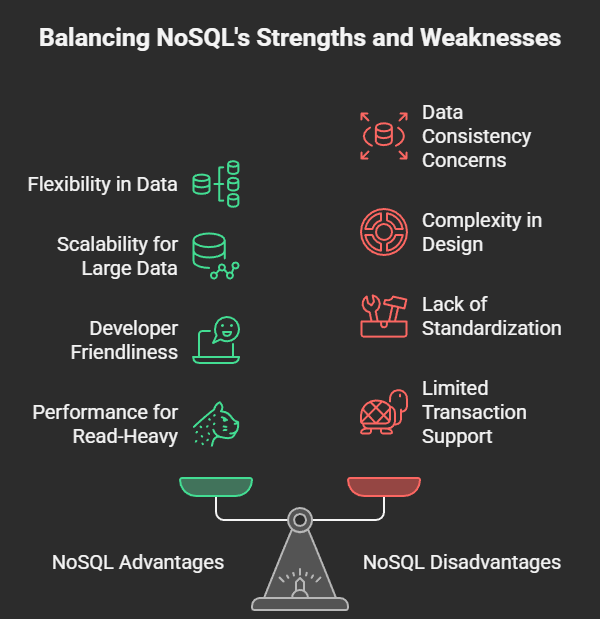
Visualizing the structural differences.
| Feature | SQL | NoSQL |
|---|---|---|
| Data Model | Tables with rows and columns | Documents, key-value, graph, or columns |
| Schema | Fixed, predefined schema | Dynamic, flexible schema |
| Scaling | Vertical (add more power) | Horizontal (add more servers) |
| ACID Compliance | Yes, strong consistency | Varies, often eventual consistency |
| Query Language | Standardized SQL | Database-specific APIs |
| Relationships | Excellent (JOINs) | Limited or requires denormalization |
| Best For | Structured data, complex queries | Unstructured data, high scalability |
The Truth About "vs"
It's not always SQL versus NoSQL. Many modern applications use both - SQL for transactional data and NoSQL for caching, logs, or real-time features. This is called polyglot persistence.
SQL Databases Deep Dive
How SQL Stores Data
Data is organized in tables with a strict schema. Each row represents a record, and columns define the attributes.
Strengths of SQL
- ACID Transactions: Atomicity, Consistency, Isolation, Durability guarantee data integrity
- Complex Queries: JOINs, subqueries, window functions for sophisticated analysis
- Data Integrity: Foreign keys, constraints, and validations at database level
- Mature Ecosystem: Decades of optimization, tools, and community support
- Standardized: SQL knowledge transfers across different databases
Limitations of SQL
- Rigid Schema: Changing structure requires migrations, can cause downtime
- Vertical Scaling: Eventually hits hardware limits; sharding is complex
- Not Ideal for: Hierarchical data, real-time streams, or highly variable structures
NoSQL Databases Deep Dive
Types of NoSQL Databases
1. Document Stores (MongoDB, CouchDB)
Store data as JSON-like documents. Each document can have different fields.
2. Key-Value Stores (Redis, DynamoDB)
Simplest model - store values by unique keys. Extremely fast for lookups.
3. Wide-Column Stores (Cassandra, HBase)
Store data in columns rather than rows. Excellent for time-series and analytics at scale.
4. Graph Databases (Neo4j, Amazon Neptune)
Store nodes and relationships. Perfect for social networks, recommendations, fraud detection.
Strengths of NoSQL
- Flexible Schema: Add fields without migrations, great for evolving data
- Horizontal Scaling: Distribute data across many servers easily
- High Performance: Optimized for specific access patterns
- Big Data Ready: Handle petabytes of data across clusters
Limitations of NoSQL
- No JOINs: Must denormalize data or make multiple queries
- Eventual Consistency: Data might be temporarily out of sync
- Less Standardized: Each database has different query syntax
- Complex Transactions: Multi-document ACID is limited or unavailable
When to Use Each
Choose SQL When:
| Scenario | Why SQL? |
|---|---|
| E-commerce transactions | ACID compliance ensures order integrity |
| Financial systems | Strong consistency for money transfers |
| ERP/CRM systems | Complex relationships between entities |
| Data warehousing & analytics | Complex JOINs and aggregations |
| Legacy system integration | SQL is the industry standard |
Choose NoSQL When:
| Scenario | Why NoSQL? | Which Type? |
|---|---|---|
| Content management | Flexible schemas for varied content | Document (MongoDB) |
| Session storage & caching | Ultra-fast reads/writes | Key-Value (Redis) |
| IoT sensor data | High write throughput, time-series | Wide-Column (Cassandra) |
| Social networks | Relationship traversal | Graph (Neo4j) |
| Real-time analytics | Horizontal scaling for big data | Document or Wide-Column |
| Mobile app backends | Flexible, JSON-native storage | Document (MongoDB) |
Real-World Examples
Netflix
Uses Both:
- Cassandra (NoSQL) - Stores viewing history, handles millions of writes per second
- MySQL (SQL) - Billing and subscription data requiring ACID compliance
Uber
Uses Both:
- Redis (NoSQL) - Real-time driver/rider matching, caching
- PostgreSQL (SQL) - Trip records, payments, driver information
Uses Both:
- Graph Database - Connection recommendations, "People You May Know"
- Oracle (SQL) - Member profiles, job postings
Amazon
Uses Both:
- DynamoDB (NoSQL) - Shopping cart, session data
- Aurora/RDS (SQL) - Product catalog, order history
The Pattern
Notice how every major tech company uses BOTH SQL and NoSQL? They pick the right tool for each specific use case. This is called polyglot persistence.
Decision Framework
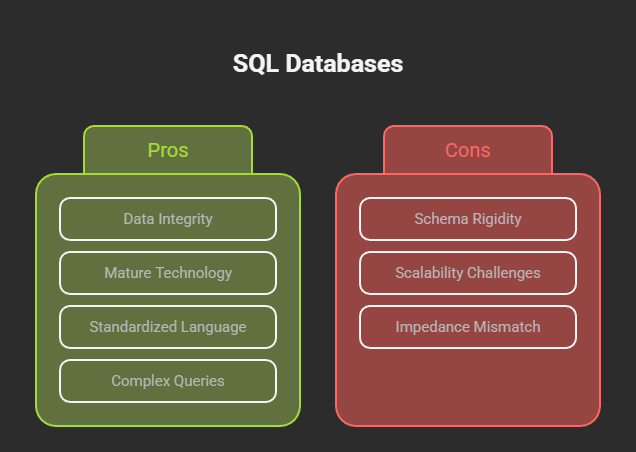
Weighing your options: When to choose which?
Ask These Questions:
1. What's Your Data Structure?
- Structured with relationships? Choose SQL
- Semi-structured or variable? Choose Document NoSQL
- Simple key-value lookups? Choose Key-Value NoSQL
- Heavy on relationships/graphs? Choose Graph NoSQL
2. How Important is Consistency?
- Must be 100% accurate always? Choose SQL (ACID)
- Can tolerate brief inconsistency? NoSQL is fine
3. What's Your Scale?
- Moderate traffic, complex queries? SQL handles this well
- Massive scale, simple queries? NoSQL shines here
4. What's Your Team's Expertise?
- Strong SQL skills? Leverage that with SQL databases
- JavaScript/Node.js developers? MongoDB feels natural
Quick Decision Tree
Common Mistake
Don't choose NoSQL just because it's "modern" or "trendy". Many projects have failed because they chose NoSQL when SQL would have been simpler and more appropriate. When in doubt, start with SQL.
Summary: SQL vs NoSQL
| Choose SQL for: | Choose NoSQL for: |
|
|
For Data Analysts
As a data analyst, you'll primarily work with SQL databases since they're better for analytics queries. However, understanding NoSQL helps when working with modern data architectures where data originates from various NoSQL sources before being loaded into SQL data warehouses.